
Partner Visa Interview and Department Requests: Legal Preparation
Preparing consistent evidence and responses when Home Affairs asks questions before a partner visa decision.
Information checked 9 October 2026
Partner visa interview preparation starts with checking the invitation, identifying the issues and comparing the application with the supporting records, if Home Affairs asks you to attend. A section 56 request seeks further relevant information, while a section 57 letter invites comment on defined adverse information within its statutory scope, according to the Migration Act 1958, sections 56 and 57.
Start by saving the complete invitation or request, its attachments and the record of when and how it was received. Identify who must respond, what Home Affairs wants, the response channel and the deadline stated in the correspondence.
Prepare truthful answers from your own knowledge and explain differences in the records rather than rehearsing a shared script. An Australian migration lawyer can organise the evidence, assess the legal issues and prepare a response that addresses the request without promising a visa grant.
Match the Department’s request to the response task.
Use the letter’s wording to identify the task; a request label alone does not explain every issue or deadline.
| Letter or contact type | Requested item or issue | Source document to check | Response action |
|---|---|---|---|
| Interview invitation | The invitation’s stated subjects and attendance arrangements | Complete invitation, lodged application, relationship chronology and relevant supporting records | Confirm the arrangements specified in the invitation, review the records and prepare to answer from personal knowledge. |
| Section 56 request | Further relevant information or documents identified in the request | Each requested item, the corresponding application answer and the relevant original record | Respond item by item, identify the supporting attachment and explain any outstanding item. |
| Section 57 letter | Adverse information identified for comment within the provision’s scope | Complete letter, disclosed material and records relevant to each issue | Address the identified information directly, distinguish agreement from dispute and substantiate the explanation. |
| Request containing inconsistent dates or accounts | A difference between information already submitted and another account or record | Application answers, earlier statements, civil records and dated communications | Identify the exact difference, establish what the records support and explain or correct it honestly. |
| Requested document not available by the deadline | A document awaiting issue, an appointment or another evidenced obstacle | Request letter, receipt, booking confirmation or correspondence showing attempts to obtain it | Request extra time before the original period expires through the instructed channel and retain the request confirmation. |
The Migration Act 1958, sections 56 and 57 distinguishes requests for further relevant information from invitations to comment on defined adverse information.
Extra time is not guaranteed, according to the Department of Home Affairs’ Partner visa frequently asked questions.
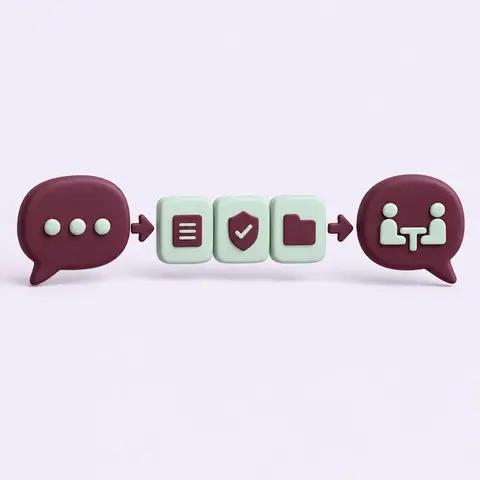
Invitation or request → identify issues and deadline → check lodged records → prepare truthful response → retain confirmation.
Before the next step
- Save the complete correspondence and notification record.
- Match each issue to the lodged answer and supporting evidence.
- Check whether extra time was granted, not merely requested.
On this page
What happens at a partner visa interview?
A partner visa interview gives Home Affairs an opportunity to ask questions about the application; the invitation determines the arrangements and any preparation it requires.
- Check the invitation. Identify the person invited, purpose, date, time, time zone and location or remote arrangements.
- Check the requested preparation. Note expressly listed documents, identification and instructions.
- Review the lodged information. Revisit relevant application answers, statements and records.
- Answer from personal knowledge. Distinguish memory, documentary evidence and what you do not know.
- Record any follow-up task. Keep correspondence and follow the instructions given.
What questions should you prepare for?
Prepare for partner visa interview questions by reviewing the issues in the invitation and the facts already supplied, rather than memorising model answers.
Illustrative evidence-review areas—not a standard Department question bank—include:
- Relationship chronology, significant dates and time apart.
- Financial arrangements in your actual circumstances.
- Household and social arrangements described in the application.
- Commitment and future plans already stated.
How does a lawyer prepare an interview?
A lawyer prepares a partner visa interview by identifying the issues, checking the lodged record and helping the applicant explain the facts accurately.
- Firstly, identify the request and the client. Establish whether advice covers applicant, sponsor or both under an appropriate engagement.
- Secondly, obtain the lodged record. Check answers, responses, statements and attachments.
- Thirdly, build a sourced chronology. Link dates to records; mark uncertainty.
- Fourthly, identify material differences. Separate clerical mistakes, incomplete records and substantive issues.
- Fifthly, practise explaining the facts. Distinguish recollection from records, without scripting answers.
- Sixthly, prepare for follow-up. Identify outstanding evidence and response methods.
What should the lawyer receive?
- Complete invitation or request and attachments.
- Receipt or notification record.
- Lodged application and available submission record.
- Relationship statements and supporting documents.
- Previous requests and responses.
- Disputed, missing or uncertain facts.
- Confirmed response or attendance deadline.
This preparation helps check the response against the actual issue and identify omissions before submission.
How do interviews and Department requests differ?
Interviews involve answering questions, section 56 requests seek further relevant information, and section 57 letters invite comment on defined adverse information under the Migration Act 1958, sections 56 and 57.
| Feature | Interview invitation | Section 56 request | Section 57 letter |
|---|---|---|---|
| Main task | Follow invitation; answer honestly | Provide requested relevant information | Comment on identified adverse information |
| Examine | Subjects and arrangements | Each item and its relevance | Disclosed information and significance |
| Prepare | Records and chronology | Indexed, item-by-item evidence | Substantiated, issue-by-issue comment |
| Governing instructions | Invitation and applicable law | Request and applicable law | Letter and applicable law |
| Does not establish | Guaranteed grant or refusal | Refusal decision | Refusal decision |
Does a section 57 letter mean refusal?
A section 57 letter is an invitation to comment on specified adverse information, not itself a visa refusal, according to the Migration Act 1958, section 57. It needs careful assessment and a substantive response.
Section 57 excludes information supplied by the applicant for the application and operates subject to statutory conditions and exceptions; it is not unrestricted disclosure of every unfavourable thought or document.
How do you identify the response deadline?
Identify the response deadline from the complete letter and its notification details, then check the applicable rules rather than assuming a standard number of days.
| Field | What to record |
|---|---|
| Letter date | Printed correspondence date |
| Notification details | How and when sent, made available or received; retain evidence |
| Response period | Exact period or due-date wording |
| Required action | Attendance, information, comment or other task |
| Submission method | Specified response channel |
| Extension correspondence | Request, decision or revised date communicated |
The Migration Act 1958, section 58 governs response arrangements for section 56 and 57 invitations; it does not establish a universal partner visa deadline.
What if the deadline is unclear?
- Preserve correspondence and notification records.
- Seek clarification through the specified channel.
- Ask an Australian migration lawyer to assess the applicable rules using the complete record.
Do not treat clarification as suspending the deadline. A pre-decision response deadline is different from a deadline for challenging a refusal decision.
How are gaps or inconsistencies addressed honestly?
Address gaps or inconsistencies by identifying the difference, checking the original records and explaining what is accurate, uncertain or unavailable.
| Issue | Check first | Honest response approach |
|---|---|---|
| Different relationship dates | Events described; dated records | Distinguish first contact, meeting, relationship commencement and living arrangements |
| Time apart | Travel, work, residence and communications | Explain actual arrangements; do not invent cohabitation |
| Financial records in one name | Account use and payments | Explain arrangements; do not manufacture joint transactions |
| Different applicant and sponsor accounts | Original statements; personal knowledge | Identify differences without pressuring either person |
| Incorrect earlier answer | Submitted answer; correcting evidence | Expressly identify and correct the mistake through the appropriate channel |
| Uncertain recollection | Dated records; memory limits | State uncertainty rather than inventing an exact date |
Should the applicant and sponsor give identical answers?
The applicant and sponsor should give accurate answers from their own knowledge, not rehearse identical wording. Different recollections are not necessarily contradictions about material facts. Their roles and interests remain separate; the sponsor does not control the applicant’s response.
What if a document is not available in time?
Request extra time before the original response period expires and provide evidence of attempts to obtain the document, as the Department of Home Affairs’ Partner visa frequently asked questions advises.
- Firstly, identify the outstanding item. Use the request’s wording.
- Secondly, explain the obstacle. Describe the actual reason and known issuing or appointment arrangements.
- Thirdly, attach evidence of attempts. Include an available receipt, booking or correspondence.
- Fourthly, submit through the instructed channel. Check the letter and current Department instructions.
- Fifthly, retain confirmation and check the reply. Record any extension actually granted.
Does requesting extra time extend the deadline?
Requesting extra time does not guarantee an extension, according to the Department of Home Affairs’ Partner visa frequently asked questions.
Do not assume the deadline has changed; check the Department’s reply and obtain advice about responding to the outstanding request.
Arrange partner visa legal advice
Consider an Australian migration lawyer to assess the invitation or request, identify the relevant legal issues, organise the supporting records and prepare a truthful response within the applicable timeframe.
Legal preparation does not guarantee a visa grant, and the Department decides the application.
What affects the lawyer’s quote?
Request a written quote in A$ for the defined work, including whether it covers interview preparation, evidence review, a written response and follow-up correspondence.
Clarify:
- Number and nature of issues.
- Volume of lodged material.
- Missing records and inconsistencies.
- Inclusion of a section 57 response.
- Separate applicant and sponsor advice scopes.
- Meetings, drafting, revisions and follow-up.
- GST and separately charged disbursements.
Which related guide matches your next task?
Use Partner Visa Consultation to identify the scope of advice needed for the invitation, deadline and evidence.
Use Partner Visa Application when the response requires checking how the original application and supporting material were prepared.
Request legal help with the complete invitation or request, the known deadline and a short description of the issue.